Myeolchi Kkwari Gochu Bokkeum (멸치 꽈리고추 볶음)
There are some Korean side dishes that always bring back childhood memories.
For me, this is one of them.
Before school lunches became common in Korea, we brought our own lunchboxes to school.
Every morning, my mom packed rice and a few side dishes for me.
And myeolchi kkwari gochu bokkeum, stir-fried anchovies with shishito peppers, was one of the side dishes she often made.
The anchovies were salty and savory, and the peppers had a little spicy kick.
Together, they were so good with rice.
Honestly, I didn’t need much else.
Give me a bowl of warm white rice and this one side dish, and I could easily finish the whole bowl.
Even now, this is still one of my favorite side dish(밑반찬[mitbanchan])
It is simple, keeps well in the refrigerator, and tastes wonderful with rice.
Today, I’d like to share this simple Korean home-style side dish with you.
Two Simple but Nutritious Ingredients
Before we start cooking, let’s talk about our two main ingredients.
🐟 Dried Anchovies (멸치)
Dried anchovies are used all the time in Korean cooking.
We use larger dried anchovies to make broth, while smaller ones are often stir-fried and served as a side dish.
One nice thing about small dried anchovies is that we eat the whole fish, including the tiny bones.
They provide protein and minerals such as calcium.
Maybe that’s one reason Korean moms have loved putting 멸치볶음 in their children’s lunchboxes for so many years.
🌶️ Kkwari Gochu (꽈리고추)
Kkwari gochu is a small, thin Korean pepper with a wrinkled skin.
If you live in the United States, shishito peppers are a good substitute and are much easier to find.
Peppers are a good source of vitamin C, and they also bring fresh flavor to this dish.
Most kkwari gochu are fairly mild, but every once in a while, you may get a spicy one.
That’s part of the fun!
The slightly bitter and sometimes spicy flavor of the peppers goes very well with salty dried anchovies.
Now let’s cook!
Ingredients
- 100 g dried anchovies
- 1 handful kkwari gochu (꽈리고추), or shishito peppers
- 1 tablespoon cooking oil
- 1 tablespoon soy sauce
- 1 tablespoon rice syrup
- ½ tablespoon sugar
- ½ tablespoon minced garlic
- 1 teaspoon sesame oil
- Sesame seeds
You can adjust the soy sauce depending on how salty your dried anchovies are.
Instructions
1. Prepare the Peppers
Wash the kkwari gochu and dry them well.
Remove the stems.
If the peppers are small, you can leave them whole.
If they are large, cut them in half.
You can also make a small hole in each pepper with a fork or toothpick. This helps the seasoning get inside.
2. Toast the Anchovies
Heat a frying pan over medium-low heat.
Add the dried anchovies without any oil.
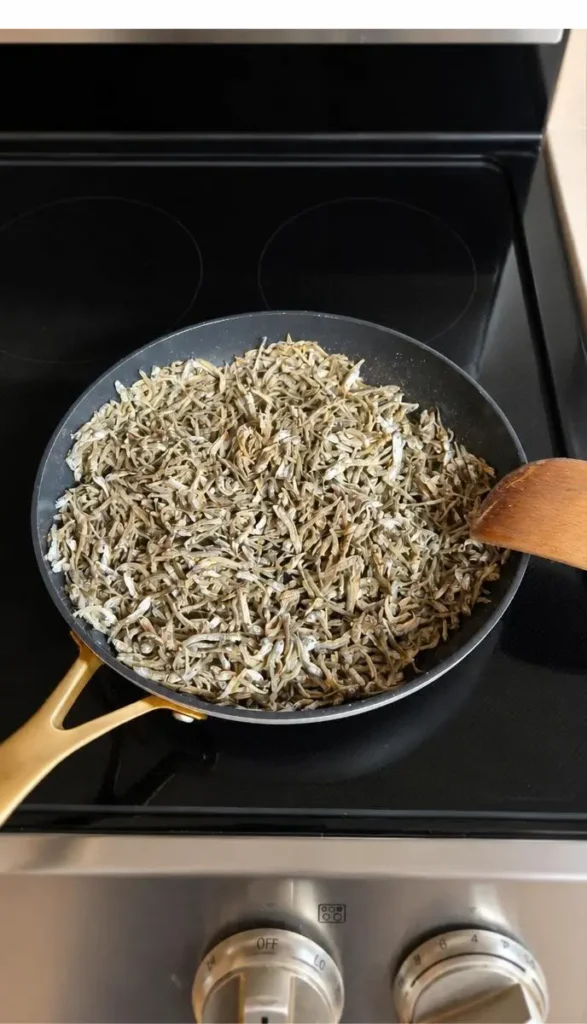
Stir them for a few minutes.
This helps remove moisture and reduces the fishy smell.
When the anchovies feel dry and slightly crispy, take them out of the pan and set them aside.
3. Cook the Peppers
After toasting the anchovies, you may see some small anchovy pieces or powder left in the pan.
If there is a lot, remove it and wipe the pan clean before you continue cooking.
Otherwise, the small pieces can burn and make the dish look and taste less clean.
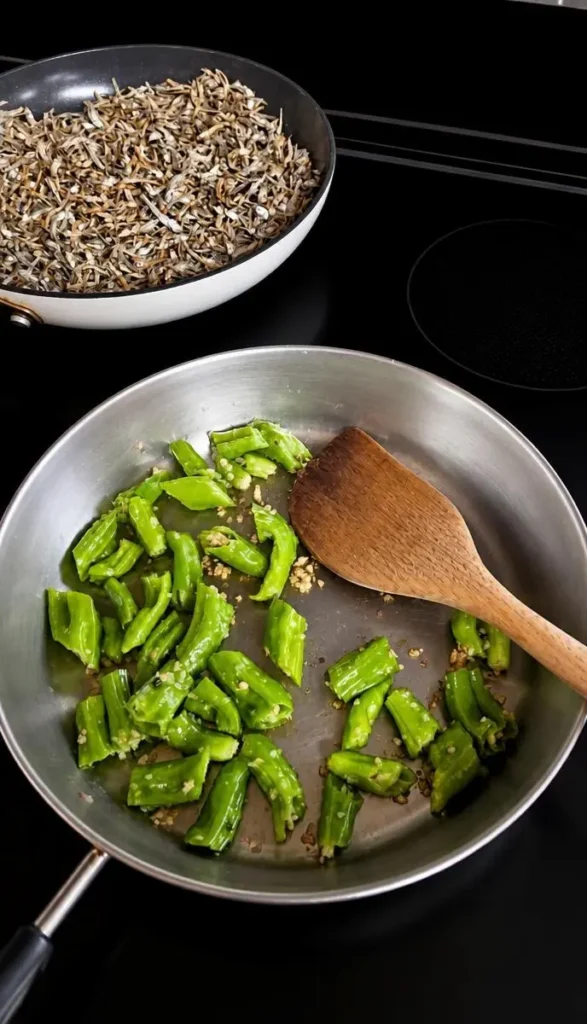
I usually like to cook everything in one pan, but this time I was short on time, so I cooked the peppers in another pan while the anchovies were toasting.
Add the cooking oil to the clean pan.
Add the kkwari gochu and cook for about 2 to 3 minutes.
Stir often.
The peppers should become a little softer, but don’t cook them until they are too soft.
We still want them to have some texture.
4. Add the Seasoning
Lower the heat.
Add the soy sauce, rice syrup, sugar, and minced garlic.
Mix everything with the peppers.
Let the sauce bubble gently for a short time.
5. Add the Anchovies
Add the toasted anchovies back into the pan.
Mix everything together until the anchovies and peppers are lightly covered with the sauce.
You don’t need to cook them for a long time.
The anchovies are already crispy, so just give everything a quick stir.
6. Finish
Turn off the heat.
Add the sesame oil and sprinkle sesame seeds on top.
Give everything one final mix.
That’s it!
Your Myeolchi Kkwari Gochu Bokkeum is ready.
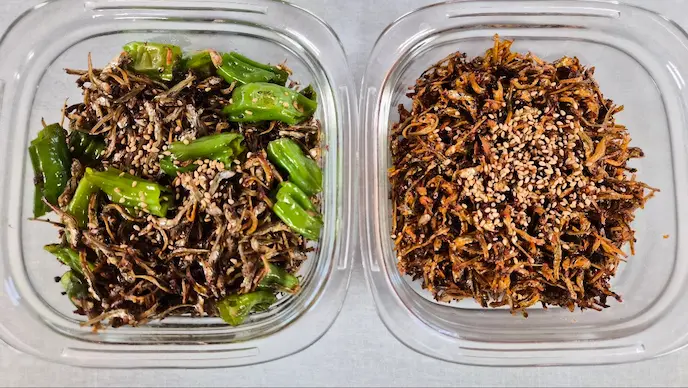
This time, I made two different kinds of stir-fried anchovies.
On the left is Stir-Fried Anchovies with Kkwari Gochu, the side dish I shared with you today.
On the right is the Spicy Stir-Fried Anchovies I shared before. This one is red and spicy, made with Korean red pepper.
If you’re curious about this version too, click here to check out the recipe.
How to Serve It
Of course, my favorite way to eat this is very simple.
Warm white rice.
That’s all I need.
Take a little anchovy, one pepper, and a spoonful of warm rice together.
Salty, savory, a little sweet, and sometimes a little spicy.
This is Korean home food for me.
You can also serve it with soup, kimchi, fried eggs, or other Korean side dishes.
Jin’s Cooking Tips
🐟 Toast the anchovies first.
Don’t add oil at the beginning. Toasting the anchovies in a dry pan helps remove moisture and the fishy smell.
🌶️ Don’t overcook the peppers.
Kkwari gochu tastes better when it still has a little texture.
🥢 Taste your anchovies first.
Some dried anchovies are much saltier than others. If yours are already salty, use a little less soy sauce.
🍚 Rice syrup adds sweetness and shine.
I like using rice syrup because it gives the sauce a nice glossy look without making it too sweet.
❤️ One Last Thought
When I was young, this was just another side dish in my lunchbox.
I didn’t think it was special.
It was simply something my mom made.
But now, when I make it myself, I think about those lunchboxes and the food my mom prepared for me every morning.
Maybe that is why I still love this simple side dish so much.
Food doesn’t have to be fancy to stay in our memories.
Sometimes a little anchovy, a spicy pepper, and a bowl of warm rice are enough.
I hope you enjoy this simple taste of a Korean home.
Happy cooking!
Love,
Auntie Jin
Learn Korean with Food
꽈리고추 (Kkwari Gochu)
고추 (gochu) means pepper.
꽈리고추 (kkwari gochu) is a small Korean pepper with thin, wrinkled skin.
It is usually mild, but sometimes you may find a spicy one!
밑반찬 (Mitbanchan)
밑반찬 means a side dish that you can make ahead and keep in the refrigerator for several meals.
Korean families often keep several kinds of mitbanchan at home.
This stir-fried anchovy and pepper dish is a perfect example.