Learn the Most Useful Polite Expressions in Korean
In Lesson 4, you learned how to talk about everyday actions in Korean.
You practiced useful action verbs such as:
- 먹어요 (eat)
- 마셔요 (drink)
- 가요 (go)
- 와요 (come)
- 자요 (sleep)
- 읽어요 (read)
- 말해요 (speak)
- 연습해요 (practice)
Now you can already make simple Korean sentences like:
- 물을 마셔요.
- 집에 가요.
- 한국어를 연습해요.
That’s a great start!
But if you want to sound more natural and polite, you’ll need a few magic words that Koreans use every day.
In this lesson, you’ll learn the most useful polite expressions to help you speak Korean with confidence.
Let’s get started!
Lesson Goal
By the end of this lesson, you will be able to:
- Greet people politely.
- Use the most common polite expressions in Korean.
- Ask someone to repeat or speak slowly.
- Say goodbye naturally.
Today’s Key Expressions
| Korean | English |
|---|---|
| 안녕하세요. | Hello. |
| 감사합니다. | Thank you. |
| 죄송합니다. | I’m sorry. |
| 저기요. | Excuse me. (to get someone’s attention) |
| 실례합니다. | Excuse me. (before interrupting someone) |
| 괜찮아요. | It’s okay. |
| 천천히 말해 주세요. | Please speak slowly. |
| 다시 한 번 말해 주세요. | Please say it again. |
| 안녕히 계세요. | Goodbye. (to the person staying) |
| 안녕히 가세요. | Goodbye. (to the person leaving) |
Speaking Tip
1. Two Ways to Say “Excuse Me”
Although both expressions mean “Excuse me,” they are used in different situations.
저기요
Use 저기요 to get someone’s attention.
실례합니다
Use 실례합니다 before interrupting someone or walking past them politely.
💡 In real conversations, Koreans often use both expressions together.
저기요. 실례합니다.
This sounds very natural when politely starting a conversation with someone you don’t know.
2. Goodbye in Korean
Many learners confuse these two expressions.
- 안녕히 계세요 → Say this to the person who is staying.
- 안녕히 가세요 → Say this to the person who is leaving.
A simple way to remember:
- You leave → 안녕히 계세요
- They leave → 안녕히 가세요
Korean Culture Tip
In Korea, the person who is leaving usually says goodbye first.
If the host says 안녕히 가세요 before the visitor says goodbye, it can sometimes sound as if they are encouraging the visitor to leave. Although people won’t usually be offended, waiting for the person who is leaving to speak first generally feels more polite and natural.
Dialogue 1
At a Restaurant
| Korean | English |
|---|---|
| A: 저기요. 실례합니다. | Excuse me. Excuse me. |
| B: 네? | Yes? |
| A: 이게 뭐예요? | What is this? |
| B: 물이에요. | It’s water. |
| A: 죄송합니다. 다시 한 번 말해 주세요. | I’m sorry. Please say it again. |
| B: 물이에요. | It’s water. |
| A: 아! 감사합니다. | Ah! Thank you. |
Dialogue 2
Learning Korean
| Korean | English |
|---|---|
| A: 안녕하세요. | Hello. |
| B: 안녕하세요. | Hello. |
| A: 한국어를 하세요? | Do you speak Korean? |
| B: 네. 한국어를 매일 공부해요. 천천히 말해 주세요. | Yes. I study Korean every day. Please speak slowly. |
| A: 네. | Sure. |
| B. 감사합니다. | Thank you. |
Dialogue 3
Saying Goodbye
| Korean | English |
|---|---|
| A: 감사합니다. 안녕히 계세요. | Thank you. Goodbye. (I’m leaving.) |
| B: 안녕히 가세요. | Goodbye. (You are leaving.) |
Practice 1
Choose the Correct Expression
Choose the best answer.
1. Someone gives you your food.
① 감사합니다.
② 죄송합니다.
2. You didn’t understand.
① 다시 한 번 말해 주세요.
② 괜찮아요.
3. You want to get someone’s attention.
① 저기요.
② 안녕하세요.
4. Someone says, “죄송합니다.”
① 괜찮아요.
② 감사합니다.
Practice 2
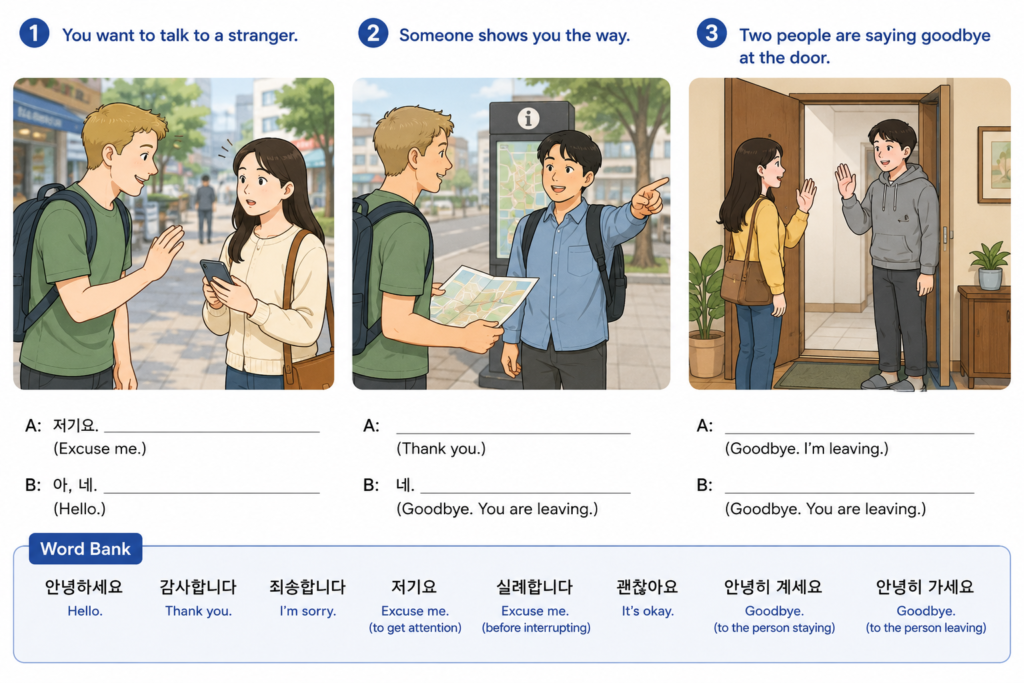
Look at the Picture and Complete the Conversation
Choose the correct expressions from the Word Bank.
💡 One expression may be used more than once.