If you love Korean food, you’ve probably heard of samgyetang… But today, I want to show you my personal favorite alternative.
It could be one of its lesser-known cousins—dak gomtang, a comforting Korean chicken soup.
I like to think of it as the simpler cousin of samgyetang.
Traditional samgyetang is made with a whole chicken, ginseng, jujubes, garlic, and several medicinal ingredients. Some of those ingredients have names that even many Koreans have trouble remembering!
Dak gomtang, on the other hand, is much simpler. It doesn’t contain ginseng or medicinal herbs, but don’t let that fool you. I think it can be just as comforting, nourishing, and satisfying as samgyetang.
In fact, if you’ve always wanted to try samgyetang but don’t care for the taste of ginseng, dak gomtang may be exactly the soup for you.
Why This Special Ingredient Makes Dak Gomtang So Good
This recipe comes from Chef Kim Daeseok’s YouTube channel.
The title of that video is “The Secret Ingredient Korean Chefs Use for Better Dak Gomtang”
I followed his recipe and made it at home.
As soon as I saw the ingredient list, one thing immediately caught my attention:
Hwangtaechae—dried pollock strips.
Some people might wonder,
“Dried fish in chicken soup?”
But that wasn’t my reaction at all.
Instead, I immediately thought,
“Oh, this is going to be delicious!”
Why?
Because I love hwangtae, and I already know how wonderfully it adds flavor to soup.
Hwangtae gives broth a clean, savory depth without overpowering the other ingredients. So when I saw Chef Kim adding it to chicken soup, I thought it was such a clever idea.
I couldn’t wait to try the recipe myself.
What Is Hwangtae?
If you’ve never cooked Korean food before, hwangtae may be completely new to you.
Hwangtae is pollock that is dried outdoors during the cold Korean winter. As it repeatedly freezes at night and thaws during the day, it develops a light, airy texture and a rich, concentrated flavor.
When it is torn into thin strips, it is called hwangtaechae.
Don’t worry—it doesn’t make the soup taste strongly fishy.
Instead, it quietly adds a clean and savory umami flavor to the broth. It is one of those humble ingredients that works behind the scenes, making the soup taste deeper and more satisfying.
One of My Favorite Korean Comfort Foods
One of my favorite Korean soups is hwangtaeguk, or dried pollock soup.
Whenever winter arrives, I find myself craving a warm bowl of it. It has a gentle, comforting flavor that always makes me feel a little closer to home.
You may also have seen dried pollock soup on the Korean TV show Unexpected Business, where actor Zo In-sung prepared it for customers.
Because I already knew how delicious hwangtae could be in soup, I had a feeling it would pair beautifully with chicken broth.
Now, let’s find out whether I was right.
Ingredients
For the Chicken Broth
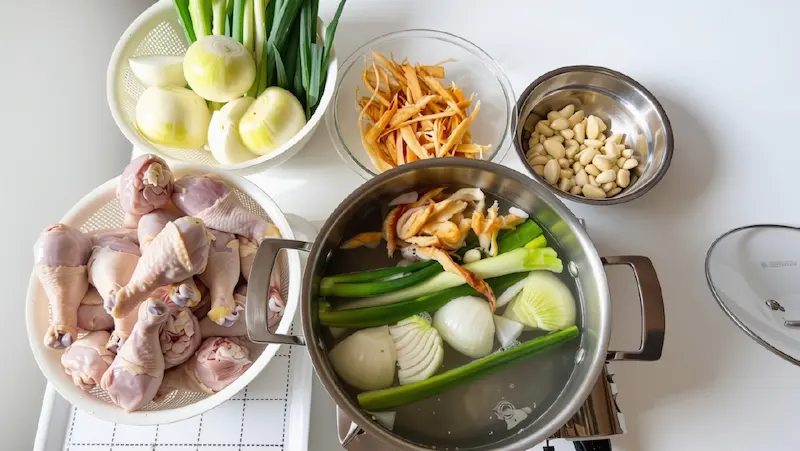
- 1 kg (2.2 lb) bone-in chicken drumsticks, about 5 large pieces
- 7 cups (1.7 L) water
- 30 g dried pollock strips (hwangtaechae)
- 1 large Korean green onion (daepa, 대파)
- ½ onion, cut into large pieces
- 8 garlic cloves
- 2 tablespoons mirim, Korean cooking wine
- ½ tablespoon coarse sea salt
🍋A Note About Green Onions
You may notice that Korean recipes often call for daepa (대파), which literally means “Big green onion.”
It is one of the most important aromatic vegetables in Korean cooking.
When simmered in soups and broths, daepa releases a natural sweetness and a deep, savory aroma while helping reduce any strong smell from the meat.
That’s why Korean cooks almost all the time use daepa when making soups like Dak Gomtang, Galbitang, or Seolleongtang.
For Seasoning the Chicken
- 1 tablespoon minced garlic
- 1 tablespoon Korean soup soy sauce (guk-ganjang)
- 1 tablespoon sesame oil
- A few shakes of ground black pepper
For Serving
- Cooked rice
- ½ green onion, thinly sliced
- Additional salt, if needed
Instructions
Before we start cooking, I’d like to mention one thing.
This is not my original recipe.
I followed Chef Kim Daeseok’s recipe because I was so curious about the combination of chicken and hwangtae, and I absolutely loved the result.
His instructions were clear, easy to follow, and the soup turned out wonderfully.
So in this section, I’ll simply share the cooking process as he explained it, along with a few notes that I found helpful while making it myself.
Now, let’s get cooking!
1. Blanch the Chicken
Bring a large pot of water to a full boil.
Carefully add the chicken drumsticks and blanch them for 3 minutes.
There is no need to rinse the raw chicken before blanching it. Placing it directly into boiling water helps remove excess fat, foam, and impurities without splashing raw chicken juices around your sink.
After 3 minutes, transfer the chicken to a colander.
Rinse the blanched chicken under cold running water, gently rubbing away any foam or residue from the surface.
Wash the pot before using it again to make the broth.
2. Rinse the Dried Pollock
Place the dried pollock strips in a bowl of cold water.
Gently swish them around for just a few seconds, then lift them out and squeeze out the excess water.
There is no need to soak them for a long time. A quick rinse is enough.
This helps freshen the dried pollock, especially if it has been stored for a while, while still keeping all that wonderful savory flavor for the broth.
3. Begin Making the Broth
Pour 7 cups of fresh water into the clean pot and bring it to a boil.
Once the water is boiling, add the blanched chicken along with:
- ½ tablespoon coarse sea salt
- 8 garlic cloves
- ½ onion
- 1 whole green onion
- The rinsed dried pollock strips
- 2 tablespoons mirim
At this point, all the ingredients begin working together to create the broth.
The chicken adds richness, while the garlic, onion, green onion, and dried pollock add layers of flavor.
4. Simmer the Soup
Cover the pot and allow the broth to return to a boil.
Once it begins boiling again, reduce the heat to medium and simmer for 30 minutes.
You want the soup to maintain a steady boil, but not such a strong one that the broth splashes all over your stove.
As it cooks, the chicken will become tender, and the hwangtae will add its clean, savory flavor to the broth.
Your kitchen should begin to smell very comforting around this time.
5. Remove the Chicken and Other Ingredients
After 30 minutes, turn off the heat.
Carefully remove the chicken drumsticks and place them on a plate or tray to cool.
Remove the onion, green onion, garlic, and dried pollock from the broth as well.
These ingredients have already given their flavor to the soup, so they do not need to be served in the final bowl.
Skim off any excess foam or oil floating on top of the broth.
You don’t have to remove every little drop of chicken fat. A little bit adds flavor. Just remove enough to keep the broth clean and pleasant.
6. Shred and Season the Chicken
Once the chicken is cool enough to handle, remove the meat from the bones.
Discard the bones, skin, and any tough pieces of cartilage.
Gently tear the chicken into bite-sized pieces and place it in a mixing bowl.
Add:
- 1 tablespoon minced garlic
- 1 tablespoon Korean soup soy sauce
- 1 tablespoon sesame oil
- A few shakes of black pepper
Mix everything gently until the chicken is evenly seasoned.
Please don’t skip this step.
Seasoning the chicken separately ensures that the meat itself is flavorful—not just the broth around it.
7. Taste and Adjust the Broth
Return the broth to the stove and bring it back to a gentle boil.
Taste it before adding any more salt.
The seasoned chicken will add extra flavor when it is served, so be careful not to make the broth too salty.
Add a little more salt only if needed.
Remember: you can always add more salt, but once it is in the soup, you cannot take it back out. Auntie Jin has learned this lesson more than once!
8. Assemble the Dak Gomtang
Place a serving of warm rice in each soup bowl.
Arrange a generous portion of the seasoned shredded chicken over the rice.
Add plenty of thinly sliced green onion.
Finally, ladle the piping-hot broth over everything.
Serve immediately while the soup is nice and hot.
You can also serve the rice separately and add it to the soup little by little as you eat. Both ways are delicious, so choose whichever way feels more comforting to you.
My Honest Review
So, was I right about the hwangtae?
Yes, I was.
The dried pollock added a clean, slightly salty, savory depth that made the chicken broth taste even more refreshing.
It didn’t make the soup taste fishy—not even a little.
Instead, it enhanced the natural flavor of the chicken and made the broth taste fuller and more satisfying.
As expected from a cooking secret used by a Korean master chef, it did not disappoint.
That is exactly why I wanted to bring this recipe to the blog and share it with you.
I already loved hwangtae, and this recipe gave me one more reason to always keep some in my pantry.
If you’ve been craving samgyetang but feel hesitant about the ginseng or medicinal ingredients, please give dak gomtang a try.
It is simple, comforting, and full of nourishing flavor.
Korean Expression: 이열치열[Iyeol Chiyeol]
Fight Heat with Heat with Dak Gomtang
Summer can be exhausting.
When you sweat a lot and lose your energy, a warm bowl of dak gomtang may be just what your body needs.
In Korea, we have an interesting expression:
Iyeol chiyeol (이열치열).
It is a four-character expression based on Chinese characters, and it literally means:
“Fight heat with heat.”
The idea is to overcome the summer heat by eating something hot.
It may sound strange at first. Why would anyone want to eat steaming-hot soup on an already hot day?
But in Korea, warm and nourishing dishes such as samgyetang are traditionally eaten during the hottest days of summer. We believe these foods help restore the energy that has been drained by the heat.
And honestly, constantly drinking icy beverages and eating only cold foods can sometimes upset your stomach.
A warm bowl of soup can feel surprisingly gentle and comforting.
So the next time a hot summer day leaves you feeling tired and drained, think of the Korean expression iyeol chiyeol.
Sit down with a steaming bowl of dak gomtang, take your time, and let it help you recharge.
I hope this comforting soup brings warmth, energy, and a little taste of Korea to your table.